
The Fujifilm Finepix X100 is a new compact camera that’s quite unlike any other available today. Featuring a retro design that bears more than a passing resemblance to the Leica M-series, the X100 is a blend of old and new, bringing together a very traditional control system with some distinctly cutting edge features. At the heart of the X100 is a 12.3 megapixel APS-C CMOS sensor, a 23mm fixed focal length F/2 lens, and a newly developed Hybrid Viewfinder. This cleverly combines an optical viewfinder and an electronic viewfinder together, with the former similar to those found in rangefinder-type film cameras but overlaid with vital shooting information. The X100 has a number of other features that are indebted to the film past, from the quiet leaf shutter, the ring around the lens for setting the aperture, dials for the shutter speed and exposure compensation, to the range of film simulation effects and the leather-like finish. Costing £999 / $1299, such attention to detail doesn’t come cheap, so carry on reading our Fujifilm X100 review to find out if it can justify its price tag.
Price $1,200
specifications
| Format | Compact |
| Price (street) |
|
| Also known as | |
| Release Status | |
 Max resolution Max resolution | 4288 x 2848 |
| Low resolution | 4288 x 2416, 3072 x 2048, 3072 x 1728, 2176 x 1448, 1920 x 1080 |
| Image ratio w:h | 3:2, 16:9 |
| Effective pixels | 12.3megapixels |
| Sensor photo detectors | |
| Sensor size | 23.6 x 15.8 mm (3.72 cm²) |
| Pixel density | 3.3 MP/cm² |
| Sensor type | CMOS |
| Sensor manufacturer | |
| ISO rating | |
| Zoom wide (W) | 35mm |
| Zoom tele (T) | 35mm |
| Digital zoom | Unknown |
| Image stabilization | No |
| Auto Focus | |
| Manual Focus | Yes |
| Normal focus range | 80cm |
| Macro focus range | 10cm |
| White balance override | 7 presets plus manual |
| Aperture range | F2.0 |
| Min shutter | 30sec |
| Max shutter | 1/4000sec |
| Built-in Flash | Yes |
| Flash range | 9m |
| External flash | No |
| Flash modes | Auto, On, Off, Red-Eye, Slow Sync |
| Exposure compensation | -2 to +2 EV in 1/3 EV steps |
| Metering | TTL 256 zone |
| Aperture priority | Yes |
| Shutter priority | Yes |
| Focal length multiplier | |
| Lens thread | |
| Continuous Drive | Yes, 5,3 fps |
| Movie Clips | Yes, 1280 x 720 (24fps) |
| Remote control | Unknown |
| Self-timer | Yes, 2 or 10 sec |
| Timelapse recording | No |
| Orientation sensor | Yes |
| Storage types | SD / SDHC / SDXC (UHS-I) |
| Storage included | 20 MB |
| Uncompressed format | Yes, RAW (RAF) |
| Quality Levels | Fine, Normal |
| Viewfinder | Electronic (90% coverage, 0.5x magnification) |
| LCD | 2.8" |
| LCD Dots | 460,000 |
| Live View | Yes |
| USB | USB 2.0 (480Mbit/sec) |
| HDMI | Yes, Mini connector |
| Wireless | No |
| GPS | No |
| Environmentally sealed | No |
| Battery | Lithium-Ion NP-95 rechargeable battery |
| Weight (inc. batteries) | 445g |
| Dimensions | 126 x 75 x 54mm (5 x 3 x 2.1 in) |
| Notes | |
| Resolution Chart | |
| Colour Patches |
|
Ease of Use
The Fujifilm Finepix X100 is a classically styled camera that recalls film rangefinders from the past, most notably the Leica M3, with a breathtakingly beautiful retro design that elicits "oohs" and "aahs" from everyone that sees it. Importantly the X100 isn't simply mimicking what's gone before it, though, instead combining some of the stand-out features from the past with some of the most recent innovations of today. Fujifilm have built on their film heritage to create a unique digital camera that offers the best of both worlds.
That isn't to say that everyone should immediately place a pre-order for this heavily-in-demand camera. Despite its popularity amongst seasoned photographers, the X100 is still very much a niche product, with its non-interchangeable fixed focal length lens, comparatively large body, and the emphasis on a manual way of shooting that requires some experience on the part of the user. The X100 will most appeal to the street photographer, with its 23mm lens being equivalent to the classic focal length of 35mm, the oversized optical viewfinder crucially showing the subject before it moves into the frame, and the various dials making it quick and easy to control the camera while it's held up to your eye.
The Fujifilm Finepix X100 is an amazingly well-built camera, with absolutely no flex or movement in it chassis thanks to the die-cast magnesium alloy top and base plates and machined control dials. At the same time, it's actually a little lighter than a first glance might suggest, weighing in at 445g with the battery and memory card fitted. Measuring 126.5mm (W) x 74.4mm (H) x 53.9mm (D), it's taller than its closest rival, the Leica X1, although that camera doesn't have a built-in viewfinder, and as slim as compact system cameras like the Panasonic GF2 or Sony NEX-5 with a comparable pancake lens fitted. There are some plastic buttons and controls on the X100, most notably the memory card / battery compartment door and the rear circular control wheel, both of which wouldn't look or feel out of place on a cheap compact, but other that that the X100 offers the best build quality of any camera that we've ever tested.
The X100 is supplied with a push-on, lined lens cap to help protect its 23mm optic, although there's no way to connect it to the camera. You can use filters with the X100, but only by removing the ring at the front of the lens and buying the optional 49mm accessory. There's a subtle but effective hand-grip at the front and a space at the rear for your thumb, with your grip helped in no small part by the textured faux-leather surface that runs around the full width of the camera. Two small metal eyelets on either side of the body are used for connecting the supplied shoulder strap, which isn't quite as luxurious as the rest of the package. A metal tripod mount is positioned slightly off-centre from the lens and next to the memory card / battery compartment, so you'll have to remove the camera from the tripod to change either of them.
At the heart of the X100 is a 12.3 megapixel APS-C CMOS sensor, a size that's more commonly used by the majority of DSLR cameras than by your average compact. The X100 joins the very short list of compact cameras that use an APS-C sensor, which is about 10x bigger than those found in most compacts, and also larger than those in most compact system cameras. It promises to deliver image quality at least on par with DSLRs, and as our test photos and sample images show on the next two pages, the X100 actually surpasses a lot of them. We won't say any more at this point other than to recommend that you take a look at our Sample Images for yourself.
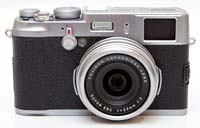 | 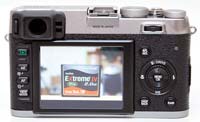 |
| Front | Rear |
Helping to keep the image quality high is the X100's fixed 23mm lens. Fujifilm revealed quite early on that they opted for a fixed lens rather than an interchangeable system to deliver the best images possible from the sensor, and although this will undoubtedly put many prospective users off the camera, we feel it's a worthwhile compromise. 35mm is a classic focal length, half-way between true wide-angle and the standard 50mm, which is roughly equivalent to human eyesight. Instead of relying on a zoom lens, the X100 forces you to get up close and personal with whatever or whoever you're photographing, adding a level of intimacy to your photographs that is often missing when shooting with a zoom.
The Fujifilm Finepix X100's lens has a fast aperture of F/2.0, which in conjunction with the large APS-C sensor makes it easy to throw the background out of focus and achieve some nice bokeh effects, helped by the 9-blade aspherical lens. The combination of the F/2.0 aperture and the extensive ISO range of 100-12,800 makes the X100 very well suited to low-light shooting, allowing you to hand-hold the camera in places where you'd usually be reaching for a tripod (if allowed) or other support. The clever ISO Auto Control setting allows you to set a maximum sensitivity (up to 3200) and a minimum shutter speed (1/30th is a good starting point), with the camera over-riding your ISO choice if it thinks you're being too ambitious whilst maintaining a shutter speed that won't introduce camera shake.
Indeed, we ran into more issues in bright sunlight than darkness, where the top shutter-speed limit of 1/1000th second at F/2 often caused over-exposure. Fujifilm have compensated for this limitation by incorporating a 3-stop Neutral Density filter, which allows the aperture to remain wide-open at F/2 even in very bright conditions, perfect for outdoor portraits where you want an out-of-focus background. You do have to delve into the menu system to turn this on, or map it to the Fn button on top of the camera, although that control is already handily assigned to the ISO speed. The ND filter can also be used to creatively slow down the shutter speed for shooting bright, fast-moving subjects like waterfalls.
Despite having a fixed focal lens, the X100 still offers a respectable close focusing distance of 10cms, so macro shooting certainly isn't out of the question. There is one small fly in the ointment though. Normal focusing is from 80cms to infinity, so if you want to get closer to your subject than that and still be able to auto-focus, you have to select the Macro mode, which in turn prohibits the use of the optical viewfinder, instead relying on the electronic one. You then have to turn off the Macro mode to return to normal focusing beyond 2ms. It's not the steps that you have to go through that's problematic, but the 80cm distance, which you'll often find yourself on the cusp of when grabbing a candid shot, especially if you're trying to fill the 35mm angle of view. Seasoned street photographers will completely circumvent this by manual focusing, but it is annoying for us mere mortals who rely on auto-focusing.
Talking of which, the Fujifilm Finepix X100's auto-focusing speed isn't exactly the quickest in the world, especially if yoiu're used to shooting with a DSLR. Compact users will be well-used to the contrast-detection system that the X100 also employs, but DSLR owners accustomed to the quick reactions of their phase-detection cameras will likely find the perceptible delay of the X100 as it locks onto the subject slightly annoying. I say slightly, because although a delay of around 1/4 second is there, it's not slow enough to be too irritating and it does lock-on virtually 100% of the time in good light, unless you do a lot of shooting in low-light where it becomes a bit more hit and miss in terms of accuracy. We'd put it on a par with the Panasonic Lumix GF1 and it's 20mm kit lens in terms of auto-focusing speed, which is faster than the Leica X1 and the early Olympus PEN cameras, but certainly not as quick as a DSLR or more recent compact system cameras like the Panasonic GH2. Again, more experienced users will opt for pre-focusing manually to be able to react in the quickest way possible, while for the rest of us the slightly sluggish AF speed is a mere blemish in the X100's performance, rather than a complete showstopper as with the Leica X1.
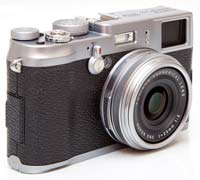 |  |
| Side | Front |
Manual focusing is activated by setting the focusing switch on the side of the camera to Manual and using the ring that encircles the lens to focus. The X100 has an electronically coupled focus-by-wire manual focusing ring, rather than a physical one, which in practice is less responsive both in terms of feel and speed. It takes a lot of turns to focus from 0.1m to infinity, so many that it's a much better idea to use the AFL/AEL button on the rear of the camera to set the focus automatically, then use the focusing ring to micro-adjust the focus manually, if required.
There's a handy blue distance scale along the bottom of the viewfinder (both the OVF and EVF) and on the LCD screen if you're using that for composition, with a red bar indicating the the focusing distance and a white bar showing the depth of field, which actually changes in line with the current aperture - very handy. In addition to the AFL/AEL button, the X100 has another trick up its manual focusing sleeve in the shape of the rear command control (the dial which sits under your right thumb). You can press this in to magnify the view in the electronic viewfinder, with the ability to then pan around the frame by pressing the AF button and spinning the command dial. This makes it much easier to judge precise focusing.
The X100 utilises a leaf-shutter rather than the focal-plane shutter that DSLR cameras have. This is a small circular shutter that's built into the lens itself, the chief benefits being near-silent operation and extremely high flash-sync speeds (up to 1/4000 second). To make the camera even less obtrusive, there's a Silent menu option which turns off the speaker, flash, AF-assist lamp and most importantly the articially-created shutter-release sound, instantly making the X100 perfectly suited to candid photography.
The Fujifilm Finepix X100 offers not one, not two, but three ways of composing your images. In addition to the high-resolution 2.8 inch LCD monitor on the back, which has 460k dots and offers 100% scene coverage, the X100 also features the much-talked-about hybrid optical viewfinder / electronic viewfinder system. Optical viewfinders are something of a dying breed amongst modern cameras, so it's very refreshing to see the reverse Galilean model on the X100, with a 0.5x magnification and low chromatic aberration and distortion. A parallax corrected framing rectangle shows roughly what the picture will include (about 90%), with the framing lines and focus point moving when the shutter button is half-pressed to show the correct framing for the current focusing distance.
So far, so good - but this is no ordinary optical viewfinder. Fujifilm have implemented an integrated prism for the electronic viewfinder onto the optical viewfinder, with the latter able to show the shooting frame and a variety of shooting data. So you get a large, bright optical viewfinder which shows a bigger area than what the camera actually captures when you take a photo, useful for seeing when moving subjects are about to enter the frame, overlaid with useful information including exposure compensation, shutter speed, aperture, focusing distance scale, an electronic level and histogram (there are 14 options in total) - even the focusing point is highlighted! And at the flick of the Viewfinder switch on the front of the camera, you can easily switch from the OVF to the EVF, which provides the same exact 100% coverage as the rear LCD screen, a parallax corrected view, accurate preview of exposure and depth of field, and the ability to see all of the information that you can view on the rear LCD.
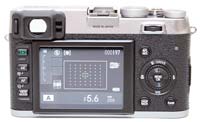 | 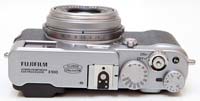 |
| Info Screen | Top |
Written down, the hybrid optical viewfinder / electronic viewfinder sounds pretty complicated, but in practice it's actually very intuitive to use. The X100 has a built-in eye sensor so that you only have to hold the camera up to eye-level to switch between the rear LCD and the hybrid optical viewfinder / electronic viewfinder (or you can press the View Mode button). Then it's simply a case of using either the bright OVF or the slightly darker EVF. I used the former for 90% of the time, helped by the camera automatically switching to the EVF to instantly playback the image, with the latter as a backup for moments when more precise framing was required or when I wanted to make a menu selection. Just make sure that you turn the electronic level on when using the OVF to help combat parallax error and keep your horizontals and verticals straight.
In terms of operational speed, the Fujifilm Finepix X100 has some real standout highlights, but also a few weak points. While we've already discussed the slightly ponderous auto-focusing, shutter lag is virtually non-existent on this camera, so once you have set the focus, you'll never miss the moment because the camera can't fire the shutter quickly enough. Continuous shooting speeds are also good, with a top rate of 5fps for 10 JPEGs or 8 RAW files if a shutter speed faster than 1/100th is used, dropping to 3fps for shutter speeds between 1/10th and 1/100th of a second. Note that both the focus and the exposure are set according to the first frame in each series, so it's not a particularly good system for tracking fast-moving subjects in varied lighting conditions.
Of greater concern for the X100's main target audience are the write speeds from pressing the shutter button to recording to the SD / SDHC / SDXC memory card. Shooting a single RAW + Fine JPEG takes about 6 seconds to record to the card, although thankfully you can take another shot almost straight away. We used a 64Gb SanDisk Ultra SDXC card for this review, which has a write speed of 15MB/s, not the fastest around, but not the slowest either. Taking a 5 frame burst took the camera 32 seconds to save, during which you can't take any more pictures. Indeed, it's so slow that the camera even provides a way of cancelling a continuous burst of images by pressing the Disp / Back button to cancel recording. Using a faster 10 speed card improved things slightly to 26 seconds for the 5fps burst and 1 second for a single shot, still not enough of a time saving to encourage you to use this feature more often.
One area in which the Fujifilm Finepix X100 excels is its handling, thanks in no small part to the numerous external controls that make changing the key settings a breeze, especially when holding the camera at eye-level. Surrounding the lens is a circular aperture ring, with 7 markings from F/2 to F/16 and an Auto setting just in case you want the camera to take control. This dial doesn't allow you to choose half-stop apertures, but you can achieve this by using the rear command control dial. On top of the X100 is a large, tactile control dial for setting the shutter speed, with settings ranging from 1/4th to 4000th second, an Auto option, a T setting for longer exposures (1/2th to 30 seconds, set via the circular command wheel) and a Bulb mode for exposures up to a whopping 60 minutes in length. Alongside the shutter speed dial is another tactile dial for changing the exposure compensation - together these three controls make it a cinch to set the exposure.
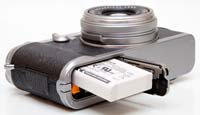 | 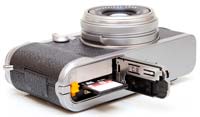 |
| Battery Compartment | Memory Card Slot |
Three other controls complete the X100's top-plate. The small but responsive shutter release button is encircled by the On/Off switch, and it has a thread for a very traditional mechanical cable release - there's no need to buy an expensive dedicated accessory for this camera. Alongside is the tiny Fn button, which by default provides quick access to the ISO speeds, but can be customised to suit your own needs from one of 10 different settings. Finally there's an external flash hotshoe for suitable dedicated external units, supplemented by the camera's built-in flash positioned just above the lens, which has a range of 50cm - 9m at ISO 1600.
The X100's LCD screen is large enough at 2.8 inches and of sufficiently high resolution (460k dots) to match the rest of the camera's high specification. I actually found myself using it much less than with a DSLR, due to the ability to use the menu system and review images via the electronic viewfinder, and you could conceivably turn off the LCD altogether to help eke out the 300 shot battery life even further. The LCD screen does have a handy Info view which presents all of the key settings at once, or you can switch to the Standard or Custom Live View modes, with the latter offering 14 customisable options (these are also used for the electronic viewfinder).
The Fujifilm Finepix X100 can record 720p movies at 24fps with stereo sound, with the option for turning this mode on curiously buried at the bottom of the Drive menu (you can, as with most things on the X100, customise this and assign the Fn button to the movie mode). It's fair to say that the X100's movie mode isn't overly advanced. You can set the aperture and shutter speed before recording begins, but not during, and you can also set the Film Simulation mode, so black and white footage is possible. Continuous auto-focusing is possible, but unfortunately you can't manually focus at all, which rules out some creative effects. There is a HDMI port for connecting the X100 to a high-definition TV, although as usual there's no cable supplied in the box. Also missing is a paper copy of the otherwise helpful manual, which is supplied on CD-ROM instead, along with the consumer MyFinepix software the slow and rather unintuitive RAW convertor (essentially a specially customised version of the commercial Silkypix application).
The X100 has a logical rear control layout. There's a vertical row of four buttons on the left of the LCD screen for image playback, exposure modes, focusing types, and the View Mode button for switching between the LCD and the OVF/EVF. On the right are the rear control dial and customisable AFL/AEL button, a circular control wheel which can be used to change the shutter speed and aperture and select other settings, and four options around it for setting the drive mode, flash mode, white balance and focusing mode. In the middle of the control wheel is the Menu button, which accesses the Shooting and Set-up menus. Underneath are two buttons, the first for changing the LCD display or going back, and the second for enabling the camera's RAW format. Although this lets you quickly switch from JPEG to RAW and back again, most X100 users will probably shoot in RAW or RAW+JPG anyway, so it feels a little redundant, especially as you can't customise it to another setting.
The Fujifilm Finepix X100 is a brilliantly-realised, beautiful and intuitive camera that's well suited to its principal use of unobtrusive, candid street photograpy. There are a few weak points in terms of its overall ease-of-use, most notably the slow write speeds and slightly sluggish auto-focusing (at least compared to a DSLR), but as a first-generation product it's remarkably well thought out and put together. Now let's find out what the X100's Image Quality is like...


